Upcoming Highlights
- Industrial Visit 🏭
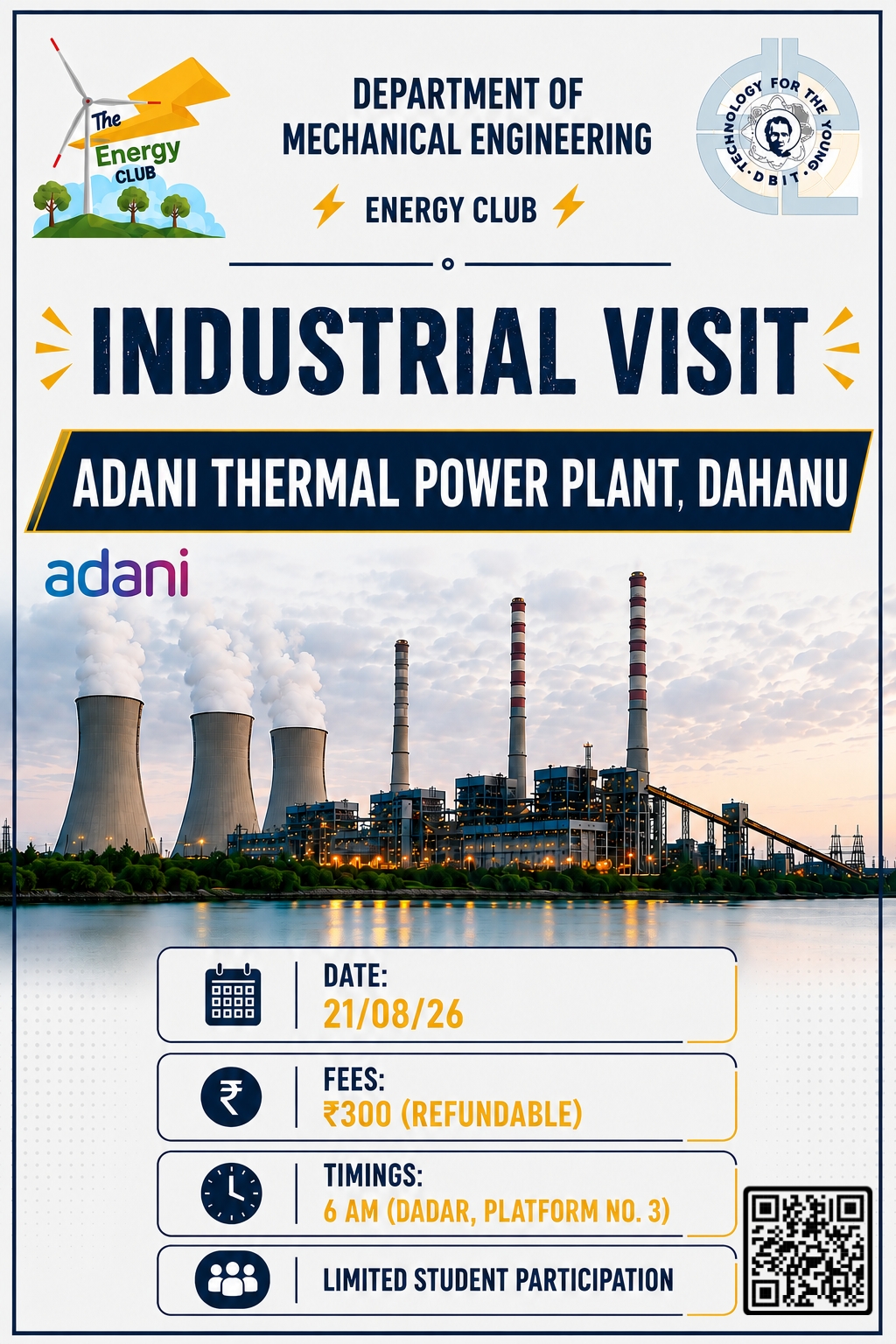
21st August 2026
Adani Thermal Power Plant Industrial Visit
Dahanu
₹300 (Refundable)
Student Feedback
The industrial visit received highly positive feedback from 26 students, with an average rating of 4.42/5. Students appreciated the practical learning, explanations by Adani engineers, safety arrangements, interaction with plant staff, and overall organization of the visit.
Visit Summary
The visit to Adani Dahanu Thermal Power Plant, Palghar, provided practical exposure to a 500 MW coal-based thermal power plant. Students learned about coal handling, pulverization, boiler and steam generation, turbines, generators, cooling systems, transformers, the 220 kV switchyard, ash handling, and ESP pollution-control systems.
The visit helped students connect concepts from thermodynamics, heat transfer, fluid mechanics, and power plant engineering with real industrial applications while gaining awareness of industrial safety, maintenance, energy efficiency, and environmental management.
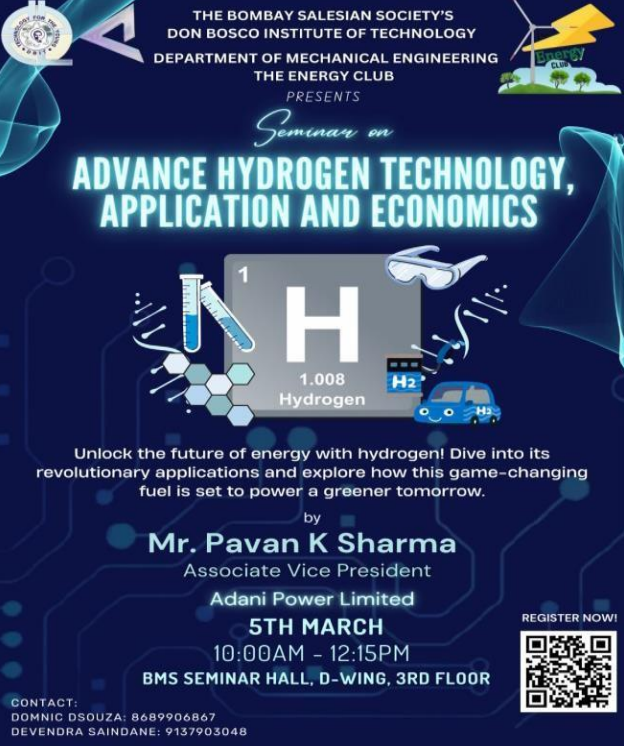
5th March 2025
ADVANCE HYDROGEN TECHNOLOGY, APPLICATION AND ECONOMICS
BMS seminar hall, D- wing, 3rd floor
Free of cost
Seminar Overview
The seminar on “Advanced Hydrogen Technology, Application and Economics” provided valuable insights into hydrogen technology and its role in the transition towards clean energy. The session was conducted with a focus on the potential of hydrogen as a sustainable energy source and its contribution towards achieving net-zero emissions.
Key Topics Covered
Students learned about green hydrogen, hydrogen production methods, storage and transportation, hydrogen fuel cells, and industrial applications. Different types of hydrogen, including green, grey, blue, pink, brown, and yellow hydrogen, were discussed along with methods such as electrolysis and steam methane reforming.
Policies & Economics
The seminar covered India’s green hydrogen initiatives, government policies, investment opportunities, economic feasibility, and market potential. The challenges associated with hydrogen storage, transportation, and large-scale adoption were also discussed.
Outcome
The session increased students’ awareness of advanced hydrogen technologies, their applications, economic aspects, and the challenges involved in developing a hydrogen-based energy future. The seminar concluded with an interactive quiz and Q&A session.
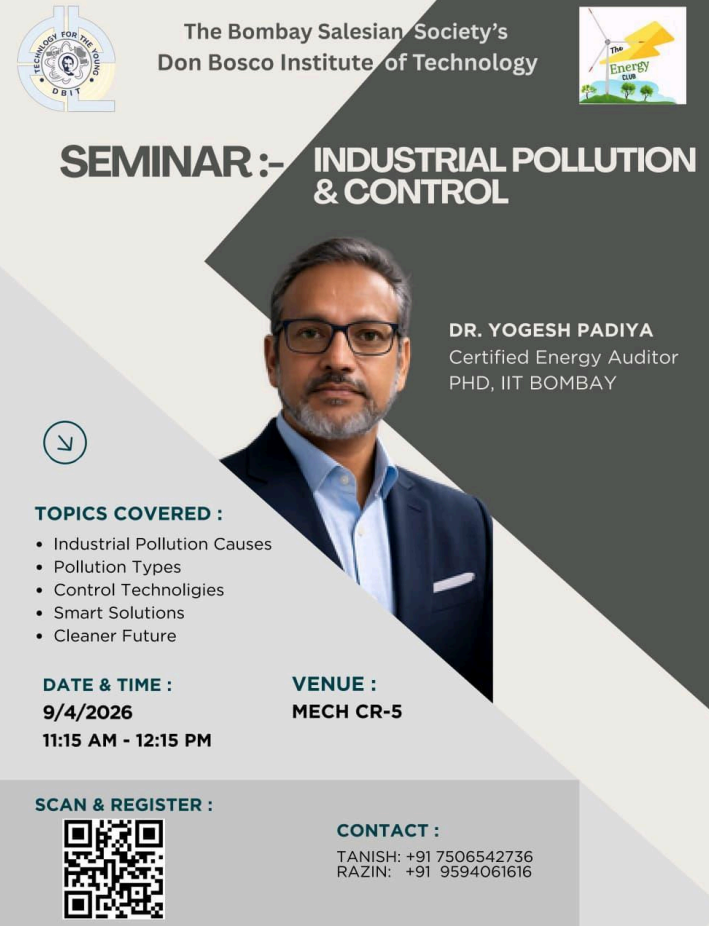
9th April 2026
Industrial Pollution and Control Technologies
Mech CR-5, 3rd Floor, C Wing
Free of cost
Seminar Overview
The seminar on “Industrial Pollution and Control Technologies” was organized by the Department of Mechanical Engineering under the Energy Club, Don Bosco Institute of Technology. The session was conducted by Dr. Yogesh Padiya and focused on industrial pollution, its environmental impact, and modern control technologies.
Key Topics Covered
Students learned about different types and sources of industrial pollution, including air, water, and noise pollution. The seminar covered major air pollutants such as particulate matter, SO₂, NOx, and CO, along with flue gas emission standards and environmental regulations.
Pollution Control Technologies
Various control methods such as Electrostatic Precipitators (ESP), scrubbers, and bag filters were explained. The session also introduced industrial wastewater treatment and the concept of Zero Liquid Discharge (ZLD) for water recovery and reuse.
Outcome
The seminar helped students understand the causes and effects of industrial pollution and the importance of sustainable pollution-control practices. It connected environmental regulations and modern technologies with their practical industrial applications.
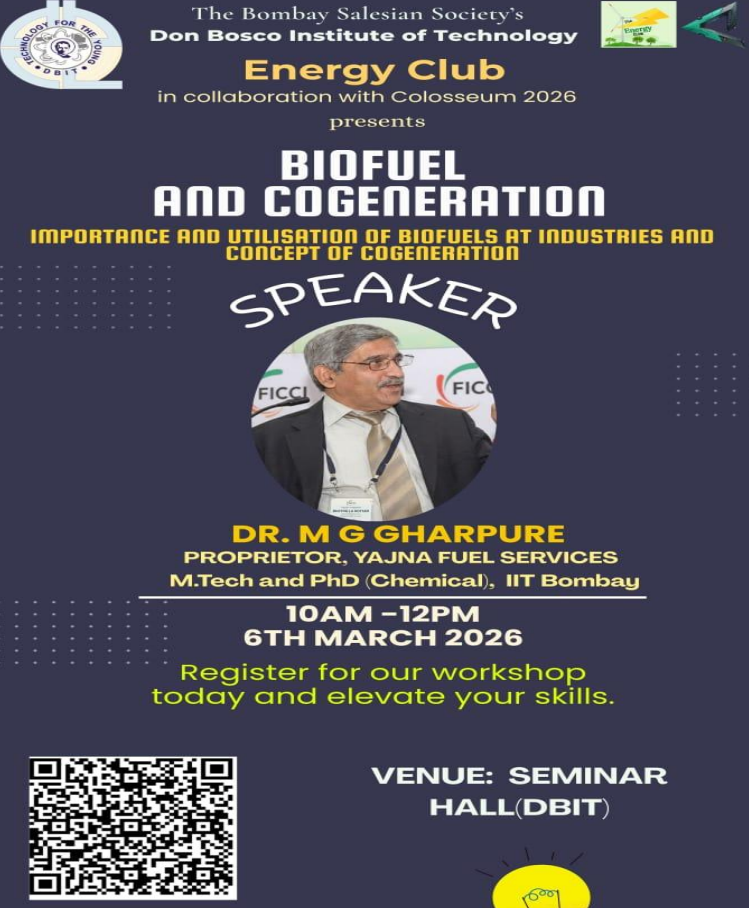
6th March 2026
Biofuel and Cogeneration
Seminar Hall, 3rd Floor, A Wing
Free of cost
Seminar Overview
The seminar on “Biofuel and Cogeneration” was organized by the Department of Mechanical Engineering under the Energy Club, DBIT. The session was conducted by Dr. M. G. Gharpure, proprietor of Yajna Fuel Services, and focused on industrial heating, sustainable fuels, and energy-efficient technologies.
Key Topics Covered
Students learned about boilers, thermic fluid heaters, and different industrial fuels such as coal, biomass, FO, HSD, LPG, and CNG. The advantages of biomass briquettes made from agricultural waste were discussed as a sustainable and economical alternative fuel.
Cogeneration & Energy Efficiency
The seminar introduced cogeneration, which enables simultaneous production of heat and electricity from a single energy source. Its application in industries such as sugar manufacturing, along with opportunities in renewable energy and energy consulting, was also discussed.
Outcome
The session helped students understand sustainable fuel selection, industrial energy management, biomass applications, and cogeneration while encouraging them to explore energy-efficient and eco-friendly technologies.
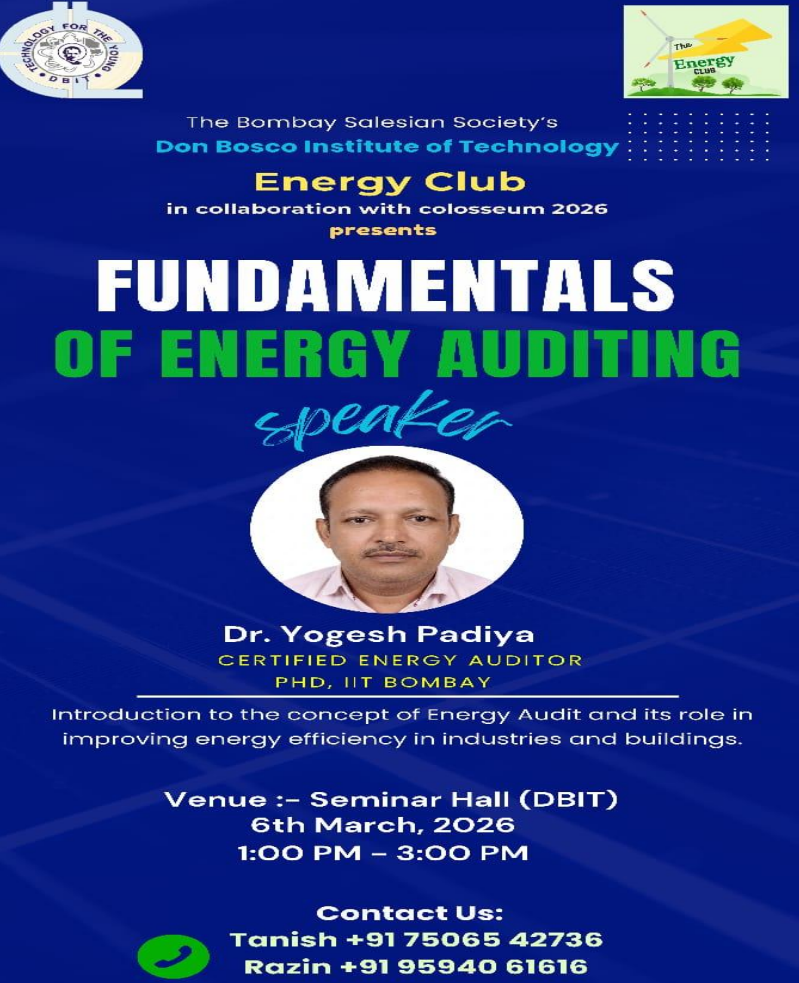
6th March 2026
Fundamentals Of Energy Auditing
Seminar Hall, 3rd Floor, A Wing
Free of cost
Seminar Overview
The seminar on “Fundamentals of Energy Auditing” was organized by the Department of Mechanical Engineering, DBIT, and conducted by Dr. Yogesh Padiya. The session focused on the importance of energy auditing in industries and commercial buildings for identifying energy losses, improving efficiency, and reducing operating costs.
Key Topics Covered
Students learned about preliminary and detailed energy audits, energy consumption patterns, methods of detecting energy wastage, and techniques for improving the efficiency of electrical and mechanical systems. The seminar also introduced instruments such as power meters, temperature sensors, and flow meters used for energy measurement and monitoring.
Energy Conservation & Efficiency
Practical industrial examples demonstrated how energy audits can help reduce electricity consumption, operational costs, and carbon emissions. The importance of energy management and conservation for sustainable development and environmental protection was also highlighted.
Outcome
The seminar provided students with practical knowledge of energy auditing, measurement, analysis, and energy-saving techniques. It encouraged them to apply energy-efficient and sustainable practices in engineering and industrial applications.
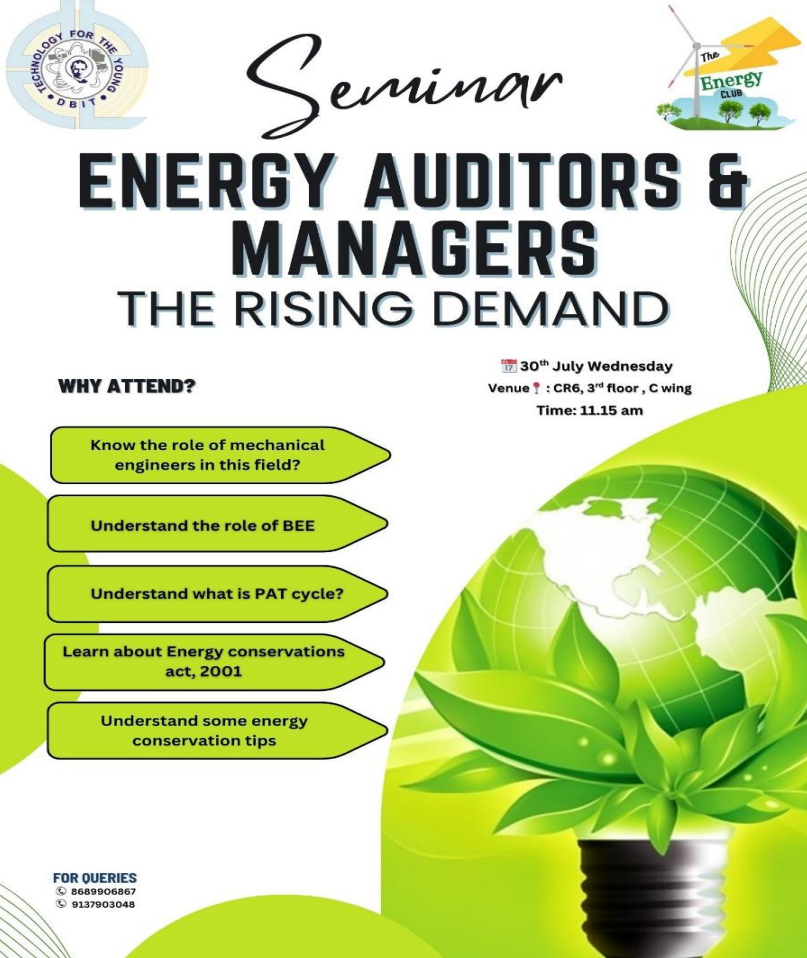
30th July 2025
Energy Auditors And Managers: The Rising Demand
Cr 6, 3rd floor C- wing, Don Bosco institute of technology
Free of cost
Seminar Overview
The seminar on “Energy Auditors and Managers: The Rising Demand” was organized by the Energy Club to create awareness about the growing importance of energy efficiency, conservation, and career opportunities in the field. The session focused particularly on the role of mechanical engineers in energy auditing and sustainable development.
Key Topics Covered
Students learned about the Energy Conservation Act, 2001, the role and functioning of the Bureau of Energy Efficiency (BEE), and the technical and policy framework governing energy efficiency in India. The seminar also covered career paths, responsibilities, and skills required for energy auditors and energy managers.
PAT & Practical Insights
The Perform, Achieve and Trade (PAT) mechanism was explained through industrial case studies, highlighting how industries implement energy-efficiency measures. Practical energy conservation tips and the importance of engineers in promoting sustainable practices were also discussed.
Outcome
The seminar helped students understand the career scope in energy auditing and management, national energy-efficiency policies, and the growing role of engineers in developing sustainable and energy-efficient solutions.
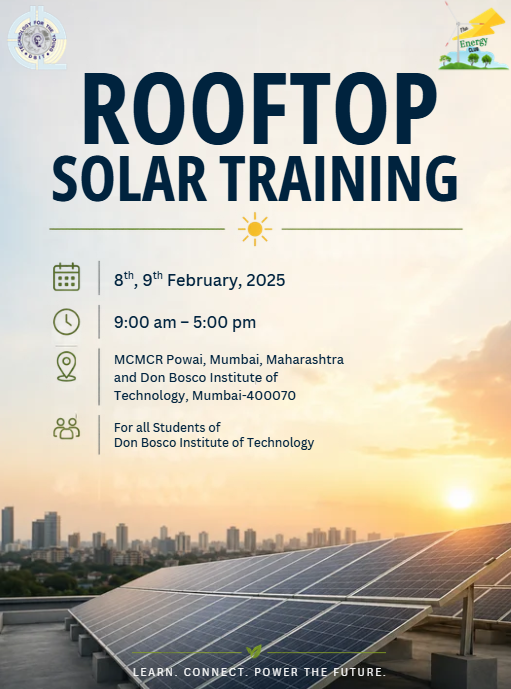
8 - 9th February 2025
Rooftop Solar training
MCMCR Powai, Mumbai, Maharashtra and Don Bosco Institute of Technology, Mumbai-400070
Free of cost
Workshop Overview
The two-day Rooftop Solar Training Workshop, held on 8th and 9th February 2025, provided DBIT students with practical knowledge of on-grid solar PV systems. Conducted by experts from Pentax Engg Pvt. Ltd., the workshop covered solar energy fundamentals, PV modules, solar radiation, inverters, and the importance of sustainable energy.
Key Topics Covered
Students learned about solar PV systems, PV modules and efficiency, solar arrays, inverters, Balance of System (BOS) components, and different types of solar systems. The training also covered financial models such as CAPEX, OPEX, and RESCO for solar projects.
Practical Training
The workshop included practical sessions on site assessment, energy estimation, rooftop solar system design, installation, operation, and maintenance. Students were introduced to Helioscope software for rooftop solar design and learned about minimizing system losses and optimizing performance.
Outcome
The training equipped students with practical knowledge of rooftop solar systems and helped them understand performance parameters such as Capacity Utilization Factor (CUF) and Performance Ratio (PR). Overall, the workshop enhanced their technical skills and awareness of sustainable solar energy solutions.
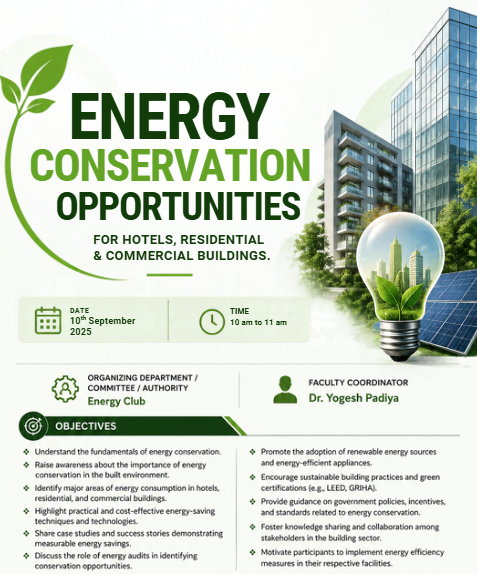
10th September 2025
ENERGY CONSERVATION OPPORTUNITIES FOR HOTELS, RESIDENTIAL & COMMERCIAL BUILDINGS.
Online
Free of cost
Webinar Overview
The webinar on “Energy Conservation Opportunities for Hotels, Residential & Commercial Buildings” focused on practical methods to reduce energy consumption and improve efficiency in buildings. The session covered energy auditing, consumption estimation, energy-saving technologies, and sustainable building practices.
Energy Conservation Measures
Participants learned about energy-saving measures for home appliances, chillers, AHUs, pumps, compressors, and water heating systems. Techniques such as efficient motors, VFDs, regular maintenance, smart controls, heat pumps, solar water heaters, and proper insulation were discussed, with practical examples showing significant energy savings.
Solar & Power Management
The webinar introduced rooftop and ground-mounted solar power systems, along with their components, feasibility, and government support. The importance of power factor improvement using capacitor banks and other techniques was also explained, along with factors involved in selecting suitable fuels.
Outcome
The session helped participants understand energy consumption estimation, conservation opportunities, solar energy, power factor management, and fuel selection, encouraging the adoption of cost-effective and sustainable energy solutions in buildings.